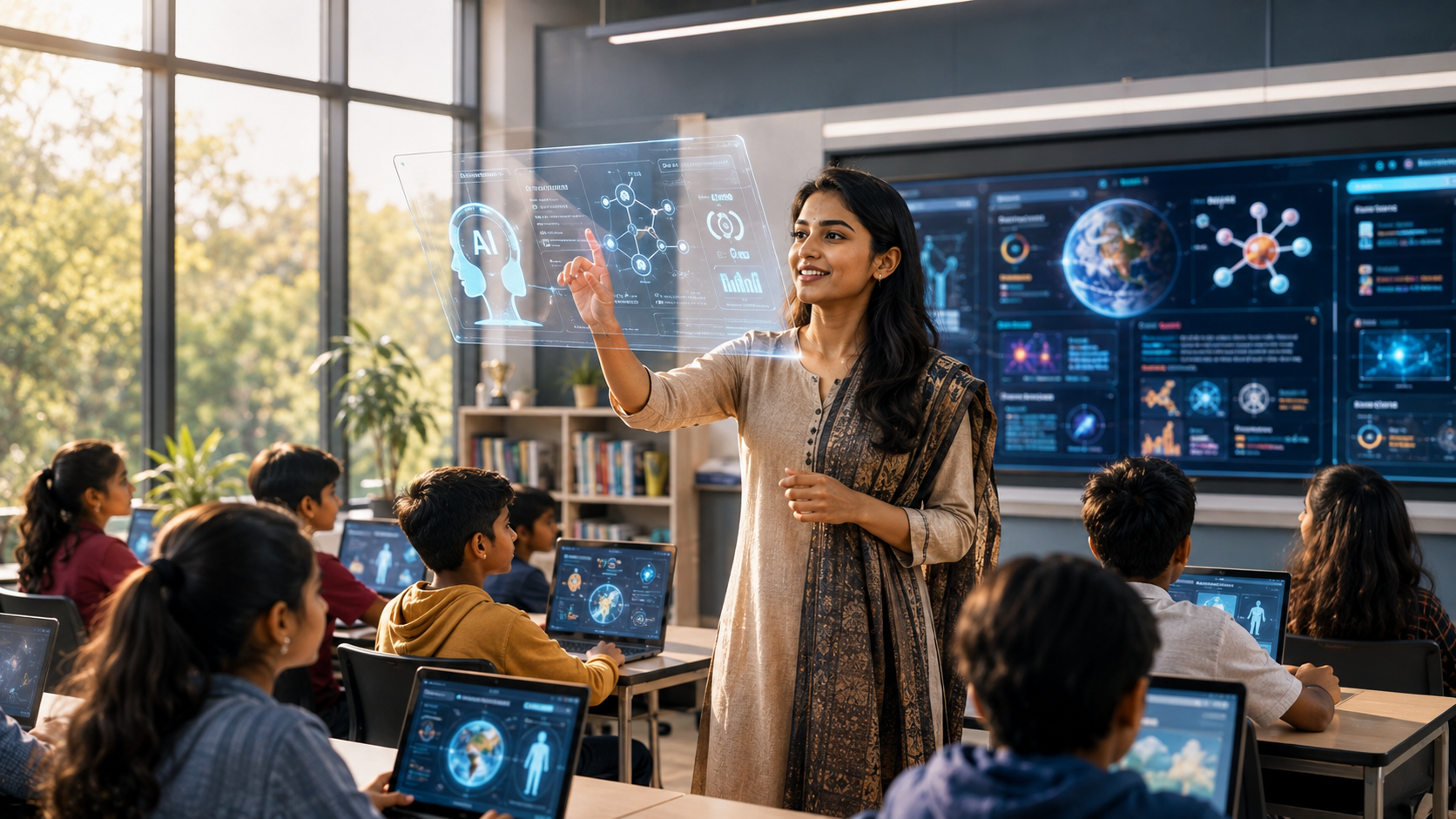
From the historic 5+3+3+4 restructuring to AI-driven classrooms, inside the 2026 revolution of Indian learning.
The Indian education system—a massive network serving nearly 24.8 crore (248 million) students across more than 14.7 lakh schools—is undergoing its most radical transformation in decades. As we move deeper into 2026, the ripple effects of the National Education Policy (NEP) 2020 are finally visible in classrooms from Mumbai to rural Meghalaya.
Gone are the days of rigid subject silos and pure rote learning. In its place is a modern, skill-driven approach designed to prepare India’s youth for a rapidly changing global economy.
Here is a neat, point-by-point breakdown of the defining features shaping the modern Indian Education System today.
1. The 5+3+3+4 Structural Overhaul
For over three decades, India followed the traditional 10+2 system. Today, schools are organized under the cognitive-based 5+3+3+4 structure. This shifts the focus toward early childhood care and aligns teaching methods with the natural developmental stages of a child’s brain.
- Foundational Stage (Ages 3–8): Focuses on play-based, multilevel learning and early childhood education (Anganwadi/pre-school + Classes 1 & 2).
- Preparatory Stage (Ages 8–11): Introduces interactive classroom learning, discovery, and foundational literacy and numeracy (Classes 3 to 5).
- Middle Stage (Ages 11–14): Introduces experiential learning in sciences, mathematics, arts, and humanities. Vocational training and internships begin here (Classes 6 to 8).
- Secondary Stage (Ages 14–18): Four years of multidisciplinary study. Students have greater flexibility to choose their subjects, dissolving the hard boundaries between “Arts,” “Commerce,” and “Science” streams (Classes 9 to 12).
Explore the Structure: Use this interactive guide to understand the curriculum shift and pedagogical goals for each age group.
2. Competency Over Rote Memorization
The era of memorizing textbooks to pass board exams is ending. The current focus is entirely on conceptual clarity and critical thinking.
- New Assessment Models: The introduction of the SAFAL framework and the PARAKH National Assessment Centre ensures that exams test core competencies and application of knowledge.
- Holistic Report Cards: Traditional marks-based scorecards have been replaced by 360-degree, multidimensional progress cards that evaluate cognitive, social, emotional, and physical development.
- Board Exam Reforms: While 10th and 12th board exams remain, they have been restructured to be easier and focused on core capacities rather than months of cramming.
3. The Digital Integration and EdTech Boom
With one of the highest numbers of smartphone users globally, India is leveraging technology to bridge the rural-urban education divide. The education budget for 2026–27 (approx. ₹1.39 lakh crore) leans heavily into digital equity.
- National Platforms: Initiatives like PM e-VIDYA and DIKSHA are delivering standardized, high-quality digital content across multiple regional languages.
- Data-Driven Governance: Systems like UDISE+ and APAAR (a unique student ID system) allow policymakers and educators to track enrollment, dropout rates, and learning outcomes with unprecedented accuracy.
- Smart Classrooms: EdTech is no longer just an after-school tutoring tool; smart school ERPs and digital portfolios are now standard administrative requirements for tracking student competency.
4. Higher Education: Flexibility and Global Reach
The reforms do not stop at Class 12. Indian higher education has been redesigned to be globally competitive and radically flexible.
- Academic Bank of Credits (ABC): Students now earn digital credits for courses completed. This allows for “Multiple Entry and Exit” points. If a student drops out of a degree after one year, they receive a certificate; after two years, a diploma; and they can return later to finish the full degree.
- Multidisciplinary Universities: Single-stream institutions (like exclusive engineering or arts colleges) are phasing out in favor of multidisciplinary universities where a student can major in Physics and minor in Music.
- Global Campuses: In a historic shift, top-tier foreign universities are now setting up independent campuses in India, and top Indian institutes (like the IITs) are opening campuses abroad, establishing India as an international education hub.